Imagine you’re trying to solve a jigsaw puzzle, but instead of having all the pieces neatly organized in a box, they’re scattered across the room. It would be a challenging and time-consuming task, right?
Well, the same can be said for managing and analyzing data in traditional databases. The relationships between different pieces of data can be complex and difficult to navigate.
This is where graph databases come in. As a type of NoSQL database, they offer a unique way of representing and storing data as nodes and relationships. Instead of relying on tables and rows, a graph database organizes data in a network of interconnected nodes and edges, enabling us to explore relationships with ease.
By leveraging the power of a backend as a service like SinglebaseCloud, we can unlock the full potential of graph databases. SinglebaseCloud offers a range of features tailored for graph data models, including a vector database, NoSQL relational document database, authentication, storage, and similarity search. With these capabilities, businesses can efficiently handle and analyze interconnected data, enabling them to gain valuable insights and make data-driven decisions.
Key Takeaways:
- A graph database organizes data as interconnected nodes and edges, enabling the exploration of relationships.
- SinglebaseCloud is a backend as a service that provides features specifically designed for graph databases.
- SinglebaseCloud offers a vector database, NoSQL relational document database, authentication, storage, and similarity search.
- By leveraging SinglebaseCloud, businesses can efficiently analyze interconnected data and gain valuable insights.
- Graph databases and SinglebaseCloud empower businesses to make data-driven decisions and drive innovation in their data-driven initiatives.
The Advantages of Graph Databases
Graph databases offer several key advantages over traditional relational databases when it comes to managing and analyzing connected data. The graph data model allows for the representation of complex relationships, such as social networks, recommendation engines, and fraud detection. With a graph database, businesses can leverage a query language specifically designed for traversing and analyzing graph data, making it easier to perform complex queries and retrieve meaningful insights.
Additionally, graph databases excel in graph analytics, which involves identifying patterns, communities, and anomalies within the data. This makes them a valuable tool for understanding and extracting insights from large and interconnected datasets. The property graph model used by graph databases allows for the addition of properties or attributes to both nodes and edges, providing rich contextual information for analysis and visualization.
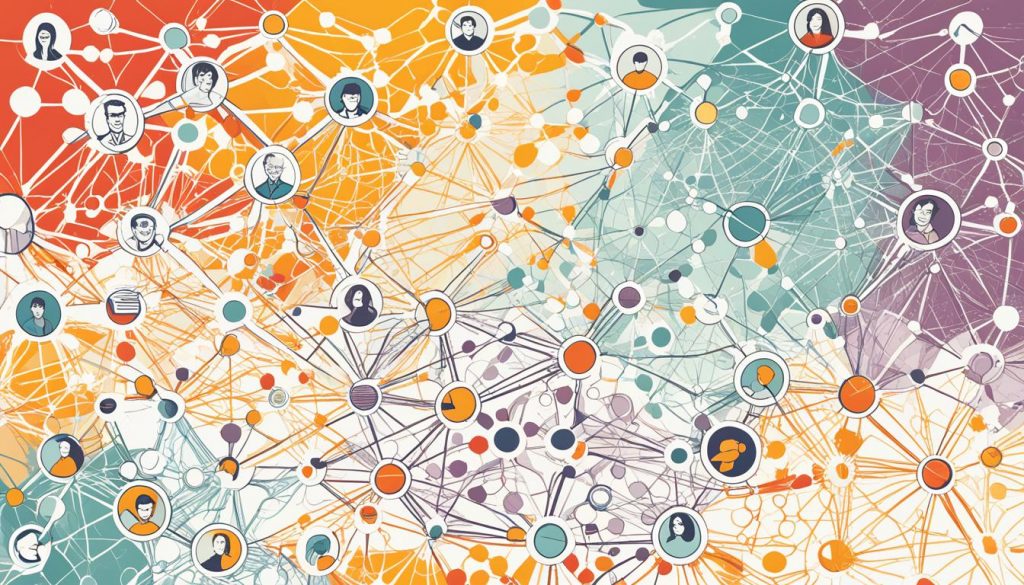
“Graph databases offer unparalleled flexibility and power when it comes to managing complex relationships and analyzing connected data. By leveraging the inherent advantages of the graph data model, businesses can unlock valuable insights and make informed decisions.”
Graph Data Model
The graph data model is a flexible and intuitive way to represent and store data as nodes and relationships. It allows for the representation of complex connections and relationships, making it ideal for applications such as social networks, recommendation engines, and fraud detection.
Query Language
A query language specifically designed for graph data enables businesses to perform complex queries and traversals, making it easier to retrieve meaningful insights. With a dedicated query language, analyzing and understanding connected data becomes more efficient and intuitive.
Graph Analytics
Graph databases excel in graph analytics, which involves identifying patterns, communities, and anomalies within the data. This capability makes them invaluable for extracting insights and discovering hidden relationships in large and interconnected datasets.
Property Graph
The property graph model used by graph databases allows for the addition of properties or attributes to both nodes and edges. This enriches the data with contextual information, facilitating analysis, visualization, and decision-making based on a deeper understanding of the connected data.
| Advantages of Graph Databases |
|---|
| Flexible representation of complex relationships |
| Dedicated query language for graph data |
| Efficient graph analytics capabilities |
| Enriched data with properties and attributes |
Use Cases of Graph Databases
Graph databases offer a wide range of applications across various industries. Let’s explore some key use cases where graph databases can provide significant value:
- Fraud Detection: With their ability to analyze complex relationships and patterns in real-time, graph databases are highly effective in identifying fraudulent activities and preventing financial losses. By utilizing advanced algorithms and graph analytics, businesses can detect and track suspicious patterns, connections, and behaviors, leading to proactive fraud prevention.
- Real-time Recommendations: Graph databases excel in providing real-time recommendations by leveraging the connections between users, products, and preferences. By analyzing the relationships and interactions within the graph, businesses can deliver personalized and relevant recommendations, enhancing user experience and driving customer engagement.
- Master Data Management: Managing and integrating complex data structures is a challenge for many businesses. Graph databases offer a solution by enabling the creation of a single, authoritative source of truth for data. This ensures consistency and accuracy in master data management, allowing businesses to make informed decisions based on reliable information.
- Network and IT Operations: Graph databases are valuable tools in optimizing network performance and identifying potential issues. By visualizing network relationships and dependencies, businesses can identify bottlenecks, optimize routing, and detect anomalies in real-time. This helps ensure efficient network operations and enhances overall system performance.
- Identity and Access Management: Managing and securing user identities and permissions is critical for businesses. Graph databases offer a comprehensive solution by capturing and analyzing the relationships between users, roles, and permissions. This enables businesses to efficiently manage access controls, detect unauthorized activities, and mitigate security risks.
As you can see, the use cases of graph databases are diverse and impactful. By harnessing the power of graph databases, businesses can gain valuable insights from interconnected data, enabling them to make data-driven decisions and drive innovation.
| Use Cases | Benefits |
|---|---|
| Fraud Detection | – Real-time identification of fraudulent activities – Proactive fraud prevention |
| Real-time Recommendations | – Personalized and relevant recommendations – Enhanced user experience |
| Master Data Management | – Single source of truth for data – Improved data consistency and accuracy |
| Network and IT Operations | – Optimized network performance – Real-time anomaly detection |
| Identity and Access Management | – Efficient management of user identities and permissions – Enhanced security and risk mitigation |
Why Choose SinglebaseCloud for Graph Databases?
SinglebaseCloud is an intuitive backend as a service platform that offers a range of features specifically tailored for graph databases. By choosing SinglebaseCloud as a backend as a service provider, businesses can harness the power of graph databases and unlock the full potential of their connected data.
“With SinglebaseCloud’s vector db and NoSQL relational document database capabilities, businesses gain the flexibility and scalability required to handle large and interconnected datasets. The platform also offers authentication and storage functionalities, ensuring the security and reliability of data. Additionally, SinglebaseCloud incorporates similarity search, making it easier to perform pattern matching and find related data points within the graph.”
With SinglebaseCloud, businesses can:
- Efficiently store and manage their graph data with the powerful NoSQL relational document database.
- Scale their database infrastructure as their data grows, thanks to SinglebaseCloud’s scalable architecture.
- Authenticate users and ensure secure access to graph data.
- Store and retrieve data reliably with SinglebaseCloud’s storage capabilities.
- Perform pattern matching and find related data points with ease using the built-in similarity search functionality.
By leveraging these features, businesses can streamline their graph database operations and focus on extracting valuable insights from their connected data. With SinglebaseCloud, the possibilities for data analysis and relationship discovery are endless.
Conclusion
Graph databases are revolutionizing the way businesses explore and analyze data relationships in today’s interconnected world. With their unique ability to represent complex connections and relationships, graph databases empower businesses to uncover valuable insights and make data-driven decisions.
By utilizing a powerful backend as a service like SinglebaseCloud, businesses can harness the full potential of graph databases and enhance their data analytics capabilities. SinglebaseCloud offers a range of features specifically designed for graph databases, including its vector database and NoSQL relational document database. These features provide the flexibility and scalability needed to handle large and interconnected datasets, ensuring businesses can effectively manage their connected data.
In addition to its advanced database capabilities, SinglebaseCloud also offers authentication and storage functionalities, ensuring the security and reliability of your data. And with its built-in similarity search feature, SinglebaseCloud makes it easy to perform pattern matching and find related data points within your graph database.
Whether it’s for fraud detection, real-time recommendations, master data management, or any other use case, graph databases offer a powerful solution for leveraging the power of connected data. With SinglebaseCloud’s seamless integration and feature-rich backend as a service platform, businesses can easily harness the power of graph databases, drive innovation in their data-driven initiatives, and stay ahead in today’s competitive landscape.
FAQ
What is a graph database?
A graph database is a type of NoSQL database that uses a graph data model to represent and store data as nodes and relationships.
How does a graph database differ from a traditional relational database?
Graph databases organize data as a network of interconnected nodes and edges, while relational databases use tables and rows.
What are the advantages of using a graph database?
Graph databases allow for the representation of complex relationships, have a query language designed for analyzing graph data, and excel in graph analytics.
What are some use cases for graph databases?
Graph databases are used for fraud detection, real-time recommendations, master data management, network and IT operations, and identity and access management.
Why should I choose SinglebaseCloud for my graph database needs?
SinglebaseCloud offers features specifically tailored for graph databases, such as a vector database, NoSQL relational document database, similarity search, authentication, and storage.