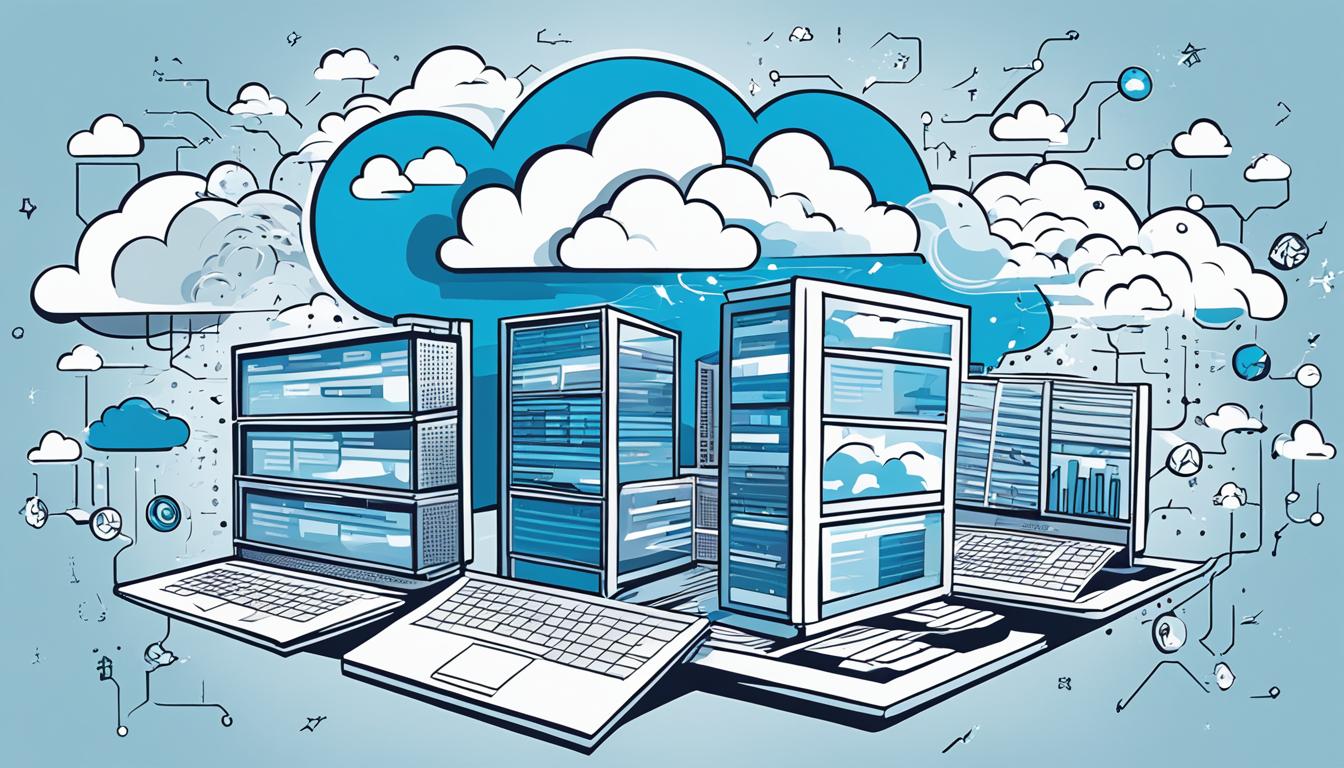
Imagine a bustling city with multiple transportation options available to its residents. Some choose to drive their own cars, others rely on public transportation, and some even combine different modes of transport to reach their destinations efficiently. Just like this diverse transportation ecosystem, hybrid cloud environments offer businesses the flexibility and freedom to mix and match different cloud computing options to meet their unique needs.
In the world of cloud computing, a hybrid cloud is a strategic combination of on-premises infrastructure, private cloud resources, and public cloud services. It enables organizations to seamlessly deploy workloads in various environments, including their own data centers, public clouds, and platform-as-a-service (PaaS) and software-as-a-service (SaaS) providers. This hybrid approach offers companies greater flexibility, scalability, and cost-effectiveness as they optimize their IT strategies.
One critical component that supports the seamless integration and management of hybrid cloud environments is Backend as a Service (BaaS), and one such powerful BaaS solution is SinglebaseCloud. SinglebaseCloud offers a range of features that empower businesses to leverage the full potential of hybrid cloud architectures. With its vector DB, businesses can efficiently store and retrieve complex data. Its NoSQL relational document database allows for flexible data modeling. Authentication services ensure secure access control, while its storage capabilities provide scalable data storage options. Additionally, the similarity search feature enables businesses to perform advanced search queries in their hybrid cloud environments.
By leveraging SinglebaseCloud’s backend as a service features, businesses can optimize their hybrid cloud integration, management, and scalability. Whether it’s deploying workloads in a multi-cloud environment, integrating public and private cloud resources, or balancing on-premises infrastructure with cloud solutions, SinglebaseCloud is a valuable asset in ensuring a smooth and efficient hybrid cloud environment.
Key Takeaways:
- A hybrid cloud environment combines on-premises infrastructure, private cloud resources, and public cloud services to optimize organizations’ IT strategies.
- Backend as a Service (BaaS), such as SinglebaseCloud, supports the integration, management, and scalability of hybrid cloud architectures.
- SinglebaseCloud offers features like vector DB, NoSQL relational document database, authentication, storage, and similarity search to empower businesses in their hybrid cloud environments.
- Hybrid cloud environments provide flexibility, scalability, and cost-effectiveness for organizations to leverage the full potential of cloud computing.
- Businesses need to stay informed about the latest developments and solutions in hybrid cloud management to harness the benefits and overcome the challenges of this dynamic technology landscape.
Understanding Hybrid Cloud Architecture
Hybrid cloud architecture combines on-premises private resources, public cloud resources, and PaaS/SaaS providers into a unified environment. It requires at least one public IaaS platform, private computing resources (such as an on-premises data center), a network connection, and a common software platform for management.
There are different approaches to hybrid cloud integration. One approach is using the public cloud as the front-end application hosting point, where the application’s user interface and frontend logic run in the public cloud while backend services are distributed across private and public clouds.
Another approach is creating a unified resource pool, where resources from both private and public clouds are combined to form a single virtual pool. This allows seamless resource allocation and management across hybrid environments.
Various hybrid cloud platforms provide solutions for building and managing hybrid cloud environments. Examples of these platforms include:
- AWS Outposts: Offers a fully managed service that extends Amazon Web Services (AWS) infrastructure, services, APIs, and tools to customers’ on-premises environments.
- Azure Stack: Enables organizations to run Azure services on-premises, providing consistency across their public and private cloud environments.
- Google Anthos: Allows users to build, deploy, and manage applications across both Google Cloud and on-premises environments, providing a consistent development and operations experience.
To better illustrate the concept of hybrid cloud architecture, let’s take a look at a visual representation:
| Hybrid Cloud Architecture Components | Description |
|---|---|
| Public Cloud | A third-party cloud provider offering virtualized computing resources, storage, and services accessible over the internet. |
| Private Cloud | An on-premises or dedicated cloud infrastructure that provides exclusive access to computing resources and services. |
| PaaS/SaaS Providers | Platforms or Software as a Service providers offering ready-to-use applications, databases, and development tools. |
| Network Connection | A reliable and secure connection that enables data transfer and communication between different cloud environments. |
| Management Software | A common software platform that helps organizations manage and orchestrate their hybrid cloud resources efficiently. |
How Hybrid Clouds Work
Hybrid clouds represent a strategic approach to deploying workloads by combining local data centers and public clouds. In this setup, businesses can leverage the unique advantages offered by both environments. Local workloads, typically mission-critical, require direct control and are best suited for on-premises deployment. On the other hand, public clouds are well-suited for less critical or short-term workloads. By utilizing public cloud resources, businesses benefit from scalable infrastructure, reduced maintenance costs, and increased agility.
However, deploying workloads across different environments introduces challenges in managing applications and data stores. This is where Backend as a Service (BaaS) solutions, like SinglebaseCloud, come into play. SinglebaseCloud offers a range of features designed to optimize integration, management, and scalability in hybrid cloud environments.
SinglebaseCloud provides key services such as:
- Vector DB: This feature enables efficient storage and retrieval of large-scale vector data, allowing businesses to process and analyze complex data sets.
- NoSQL Relational Document Database: SinglebaseCloud offers a robust NoSQL document database that combines the flexibility of NoSQL with the querying capabilities of a relational database.
- Authentication: SinglebaseCloud provides secure authentication mechanisms to ensure data privacy and prevent unauthorized access.
- Storage: With SinglebaseCloud’s storage capabilities, businesses can efficiently store and retrieve data in their hybrid cloud environments.
- Similarity Search: SinglebaseCloud’s similarity search feature enables businesses to search and match similar content or data points, enabling powerful data analytics and insights.
By utilizing these features, businesses can seamlessly integrate on-premises resources and environments with public cloud services and APIs, enabling a robust and effective hybrid cloud setup.
Embracing the Power of SinglebaseCloud
SinglebaseCloud’s feature-rich BaaS platform is designed to empower businesses in hybrid cloud environments. With its advanced capabilities, organizations can efficiently deploy and manage their workloads, harnessing the power of local and cloud resources.
Let us take a closer look at how SinglebaseCloud assists businesses in hybrid cloud setups:
| Feature | Description |
|---|---|
| Vector DB | Efficient storage and retrieval of large-scale vector data |
| NoSQL Relational Document Database | Combines the flexibility of NoSQL with the querying capabilities of a relational database |
| Authentication | Secure authentication mechanisms to ensure data privacy and prevent unauthorized access |
| Storage | Efficient storage and retrieval of data in hybrid cloud environments |
| Similarity Search | Search and match similar content or data points for powerful data analytics and insights |
Designed to streamline hybrid cloud management, SinglebaseCloud empowers businesses to harness the full potential of hybrid cloud architectures, enabling them to achieve greater flexibility, scalability, and efficiency.

Hybrid Cloud Networking and Integration
A strong network connection is crucial for a successful hybrid cloud strategy. It typically involves a WAN or dedicated networking service. To ensure connectivity, firewall rules may need to be configured.
One backend as a service (BaaS) solution that can optimize hybrid cloud networking and integration is SinglebaseCloud. SinglebaseCloud offers a range of features that can facilitate smooth integration, management, and scalability in hybrid cloud environments.
- Vector DB: SinglebaseCloud’s vector DB feature enables efficient storage and retrieval of large-scale, high-dimensional data, making it ideal for data-intensive applications and workloads in a hybrid cloud setup.
- NoSQL Relational Document Database: With SinglebaseCloud’s NoSQL relational document database, businesses can store and manage structured and semi-structured data, ensuring flexibility and compatibility with diverse cloud resources.
- Authentication: SinglebaseCloud provides authentication capabilities, allowing businesses to control access to their hybrid cloud resources and ensure the security of their data.
- Storage: SinglebaseCloud offers reliable and scalable storage options, ensuring that businesses have sufficient capacity to store and retrieve their data in hybrid cloud environments.
- Similarity Search: The similarity search feature of SinglebaseCloud enables businesses to efficiently search for similar documents or records within their hybrid cloud data, enhancing data analysis and decision-making processes.
When it comes to hybrid cloud integration, businesses have different options to consider. They can choose to use the cloud as the front-end application hosting point or create a unified resource pool. The choice depends on factors such as integration requirements, technologies, integration styles, and deployment locations. With the right integration strategy, businesses can seamlessly connect their hybrid cloud resources, environments, policies, and workflows with the resources and services offered by their chosen public cloud platform.
Here’s an example of a table comparing different integration strategies:
| Integration Strategy | Advantages | Disadvantages |
|---|---|---|
| Cloud as the Front-End Application Hosting Point | Easy access to public cloud services, effective resource utilization, scalability | Potential data transfer costs, reliance on public cloud provider for availability |
| Unified Resource Pool | Centralized management, consistent policies and workflows, improved control over resources | Potential complexity, increased infrastructure costs |
Hybrid Cloud Platforms
Hybrid cloud architecture traditionally involves building a virtualization layer on top of on-premises resources and installing a private cloud software layer. This layer provides various cloud capabilities, including self-service access, automation, resilience, and billing.
One backend as a service (BaaS) platform that offers these essential cloud features is SinglebaseCloud. With SinglebaseCloud, businesses can benefit from a powerful vector DB and a NoSQL relational document database. These database options provide flexibility and scalability for storing and managing data in hybrid cloud environments.
In addition, SinglebaseCloud offers authentication and storage capabilities, ensuring secure access to data and efficient utilization of storage resources. The platform also includes a similarity search feature, enabling businesses to search for similar patterns or data points within their hybrid cloud architecture.
A table comparing the features of SinglebaseCloud and other hybrid cloud platforms:
| Hybrid Cloud Platform | Virtualization | Private Cloud Software Layer | Additional Features |
|---|---|---|---|
| SinglebaseCloud | ✓ | ✓ | Vector DB, NoSQL relational database, authentication, storage, similarity search |
| AWS Outposts | ✓ | ✓ | Additional Amazon Web Services integrated |
| Azure Arc | ✓ | ✓ | Additional Microsoft Azure services integrated |
Moreover, there are newer hybrid cloud platforms like AWS Outposts and Azure Arc that extend public cloud services into private data centers. These platforms offer seamless connectivity and integration between public and private resources, allowing businesses to leverage the benefits of both environments. Common technologies like Kubernetes are often incorporated into these platforms to provide container-based services, further enhancing hybrid cloud architectures.
Public Cloud vs. Private Cloud
In hybrid cloud environments, both public and private cloud components are used. Public cloud relies on third-party providers for on-demand IT resources and services, while private cloud uses on-premises architecture. These two cloud models have distinct characteristics that organizations need to consider when making infrastructure decisions.
Payment Structure
One of the key tradeoffs between public and private clouds is the payment structure. Public cloud offers a pay-as-you-go model, allowing organizations to pay for the capacity they use. This flexibility makes it easier to scale resources up or down based on changing needs. On the other hand, on-premises computing requires an upfront investment in hardware, software, and infrastructure. It also involves additional costs for maintenance, upgrades, and ongoing operations.
Security
Another important factor to consider is security. With private cloud, organizations have more control over security measures and the confidentiality of sensitive data. They can implement custom security controls and compliance requirements according to their specific needs. On the other hand, public cloud providers offer robust security measures and industry-standard compliance certifications. However, organizations must trust that their data is being protected by the provider.
Availability
Availability is a critical aspect for any cloud deployment. Public cloud providers typically offer high availability and redundancy across multiple data centers. This ensures that services are accessible even in the event of hardware failures or disasters. However, there is still a risk of downtime due to external factors such as network issues or provider outages. Private cloud deployments provide more control over infrastructure and can leverage failover and disaster recovery solutions tailored to specific business requirements.
SinglebaseCloud: Optimizing Hybrid Cloud Environments
When it comes to managing hybrid cloud environments, utilizing a robust backend as a service (BaaS) solution can greatly optimize integration, management, and scalability. SinglebaseCloud is a leading BaaS platform that offers a range of powerful features:
- Vector DB: SinglebaseCloud provides a vector database that enables efficient storage, retrieval, and analysis of high-dimensional data. This feature is particularly beneficial for applications dealing with complex data models and similarity searches.
- NoSQL Relational Document Database: With SinglebaseCloud’s NoSQL relational document database, organizations can store and manage structured and unstructured data seamlessly. This flexible storage solution supports dynamic schemas and horizontal scalability.
- Authentication: SinglebaseCloud offers a robust authentication system, ensuring secure access to various applications and services within hybrid cloud environments. This feature enhances the overall security and integrity of the system.
- Storage: SinglebaseCloud provides scalable and reliable storage solutions, facilitating efficient and cost-effective data storage in hybrid cloud architectures.
- Similarity Search: SinglebaseCloud’s similarity search feature enables businesses to perform fast and accurate search operations across large datasets. This capability is particularly valuable for identifying patterns, recommendations, and other data-driven insights.
By leveraging the features of SinglebaseCloud, organizations can enhance their hybrid cloud environments, improving data integration, management, and overall performance.
Conclusion
Hybrid cloud environments offer businesses a range of benefits, including flexibility, scalability, and cost-effectiveness. With hybrid clouds, organizations can leverage both on-premises and public cloud resources to meet the specific needs of different workloads and applications. SinglebaseCloud, a powerful backend as a service, provides essential features like vector DB, NoSQL relational document database, authentication, storage, and similarity search, which can enhance the hybrid cloud experience.
Although setting up and managing hybrid cloud architectures can be complex and challenging, the rewards are significant. Careful planning, integration, and collaboration between cloud providers and on-premises infrastructure are essential for success. Despite the inherent challenges, hybrid clouds offer the ability to choose the optimal environment for each workload, optimize resource utilization, and provide robust disaster recovery options.
As the demand for hybrid cloud solutions continues to grow, staying informed about the latest developments and solutions is crucial for businesses. By keeping up with the evolving hybrid cloud landscape, organizations can make informed decisions and leverage the full potential of this technology. With its numerous benefits and the right knowledge, hybrid cloud environments can be a powerful tool for driving business growth and innovation.
FAQ
What is a hybrid cloud?
A hybrid cloud is a cloud computing environment that combines on-premises, private cloud, and third-party public cloud services.
What is hybrid cloud architecture?
Hybrid cloud architecture combines on-premises private resources, public cloud resources, and PaaS/SaaS providers into a unified environment.
How do hybrid clouds work?
Hybrid clouds involve deploying workloads in local data centers and public clouds, allowing businesses to benefit from the unique resources and services offered by public cloud providers.
How important is network connection in a hybrid cloud strategy?
A strong network connection is crucial for a successful hybrid cloud strategy, typically involving a WAN or dedicated networking service.
What are some hybrid cloud platforms?
Various hybrid cloud platforms, such as AWS Outposts, Azure Stack, and Google Anthos, provide solutions for building and managing hybrid cloud environments.
What is the difference between public and private cloud?
Public cloud relies on third-party providers for on-demand IT resources and services, while private cloud uses on-premises architecture.
What are the benefits and challenges of hybrid clouds?
Hybrid cloud environments offer flexibility, scalability, and cost-effectiveness, but setting up and managing them can be complex and challenging.