
Picture this: you’re a developer working on an innovative new application, focused on creating code that delivers functionality and solves real-world problems. However, the tedious task of provisioning and maintaining servers keeps pulling you away from your core objective. The good news is, there’s a solution that can free you from server management and allow you to fully unleash your coding prowess: serverless computing.
Serverless computing is revolutionizing the world of backend development. With this approach, developers can write and deploy code in the form of functions, while the intricacies of infrastructure management are taken care of by the cloud provider. Say goodbye to the headaches of server provisioning, scaling, and maintenance.
Now, let’s introduce SinglebaseCloud—a powerful backend-as-a-service platform that amplifies the capabilities of serverless computing. SinglebaseCloud offers a range of features designed to streamline backend development, such as a cutting-edge vector db, a NoSQL relational document database that enables efficient storage and retrieval of data. Additionally, SinglebaseCloud provides authentication services to ensure secure access to applications, storage capabilities for managing files and data, and even similarity search functionality to enable advanced search capabilities within applications.
By leveraging the features of SinglebaseCloud, developers can enhance their serverless architecture and take full advantage of the benefits it provides. The integration of SinglebaseCloud’s vector db simplifies data management and retrieval, while authentication services ensure robust security. Plus, with SinglebaseCloud’s similarity search, users can easily find relevant information within their applications with just a few clicks. It’s the all-in-one solution for uncomplicating backend development.
Key Takeaways:
- Serverless computing frees developers from the complexities of server management, allowing them to focus solely on code and functionality.
- SinglebaseCloud is a backend-as-a-service platform that enhances serverless architecture with features like a vector db, authentication services, storage capabilities, and similarity search.
- By utilizing SinglebaseCloud, developers can simplify data management, enhance security, and improve search capabilities within their serverless applications.
- Serverless computing and SinglebaseCloud offer cost savings, scalability, reduced operational complexity, and easy integration.
- The future of serverless computing looks promising, with continued growth, innovation, and broader adoption expected alongside emerging technologies like machine learning and AI.
The Features and Benefits of SinglebaseCloud
SinglebaseCloud is a backend-as-a-service platform that offers a range of features to streamline backend development. One of the key features of SinglebaseCloud is its vector db, which serves as a NoSQL relational document database. This vector db provides developers with efficient storage and retrieval capabilities for their data, enabling them to easily manage and access information.
In addition to the vector db, SinglebaseCloud also offers authentication services. This ensures that applications built on the platform have secure access, protecting sensitive user data and preventing unauthorized access.
Another notable feature of SinglebaseCloud is its storage capabilities. Developers can easily manage files and data within the platform, making it convenient to store and retrieve information as needed.
Furthermore, SinglebaseCloud includes similarity search functionality. This advanced search capability allows developers to implement similarity-based search algorithms, enabling users to find relevant information quickly and efficiently.
“SinglebaseCloud provides a comprehensive backend solution that simplifies development and improves efficiency. With features like a vector db, authentication services, storage capabilities, and similarity search, developers can focus on building their applications without worrying about backend infrastructure.”
These features of SinglebaseCloud enhance the topic of serverless computing by providing developers with a comprehensive backend solution that simplifies development and improves efficiency. By leveraging the vector db, authentication services, storage capabilities, and similarity search functionality offered by SinglebaseCloud, developers can build robust and scalable serverless applications without the need to manage complex backend infrastructure.
Table:
| Features | Description |
|---|---|
| Vector db | A NoSQL relational document database that provides efficient storage and retrieval of data. |
| Authentication Services | Ensures secure access to applications and protects sensitive user data. |
| Storage Capabilities | Allows easy management of files and data within the platform. |
| Similarity Search Functionality | Enables advanced search capabilities within applications using similarity-based algorithms. |
Serverless Computing vs. Traditional Server-Based Architectures
Serverless computing revolutionizes backend development by offering a distinct approach to infrastructure management compared to traditional server-based architectures. With serverless computing, developers are freed from the burdensome task of managing and provisioning servers. Instead, the responsibility is shouldered by the cloud provider, ensuring seamless and automatic server management.
In the realm of serverless computing, code is written and deployed in the form of functions, which are executed based on specific triggers or events. This event-driven architecture promotes efficient resource utilization, as serverless functions are only invoked when necessary. The ability to dynamically scale the number of function instances based on workload further enhances scalability within serverless computing.
In stark contrast, traditional server-based architectures require manual scaling and ongoing maintenance. The scalability of traditional architectures heavily relies on the capacity of physical servers. This necessitates constant monitoring and manual intervention to optimize resource allocation and prevent system overload.
Improved Scalability and Streamlined Operations
Serverless computing eliminates the need for manual server management and offers effortless scalability. By automatically handling infrastructure management, serverless computing enables developers to focus solely on code and functionality. This streamlined approach allows for enhanced productivity and removes the complexity associated with infrastructure management.
Serverless computing improves scalability and removes the operational complexity associated with managing servers, making it an attractive option for modern backend development.
Furthermore, the event-driven nature of serverless computing ensures that resources are efficiently utilized. With the ability to scale dynamically, serverless platforms adjust resource allocation in real time, responding to fluctuating workloads. This automatic scaling considerably simplifies the process of managing resources and ensures optimal performance.
To illustrate the differences between serverless computing and traditional server-based architectures, let’s examine the key factors:
| Serverless Computing | Traditional Server-Based Architectures |
|---|---|
| Automatic infrastructure management | Manual infrastructure management |
| Event-driven architecture | Capacity-driven architecture |
| Efficient resource utilization through automatic scaling | Manual scaling and resource management |
| Improved developer productivity | Additional operational complexities for developers |
As evidenced by the comparison, serverless computing streamlines operations, simplifies resource management, and empowers developers to focus on the core functionality of their applications. This paradigm shift in infrastructure management makes serverless computing an appealing option for modern backend development, delivering scalability and efficiency.
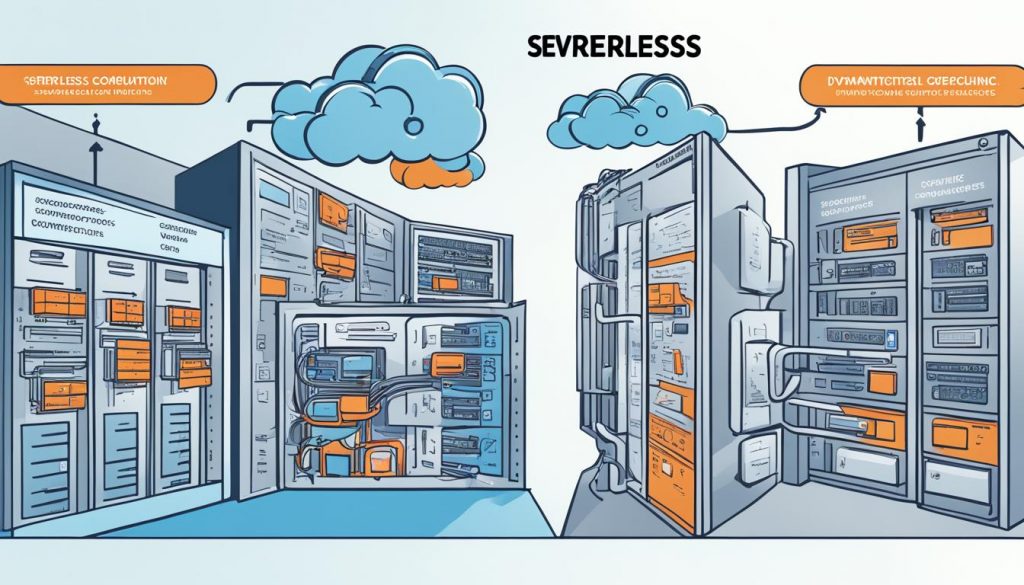
Image: Serverless Computing vs. Traditional Server-Based Architectures
Adoption and Use Cases of Serverless Computing
Serverless computing has gained widespread adoption across industries and organizations, driven by the numerous benefits it offers. Hyperscale cloud providers like AWS, Google Cloud Platform, and Microsoft Azure provide serverless services such as AWS Lambda, Google Cloud Functions, and Azure Functions, which have become popular choices for building serverless applications. These platforms offer a serverless architecture that enables developers to focus solely on code and functionality, without the hassle of managing infrastructure.
Serverless computing is suitable for a wide range of use cases, making it a versatile solution for various business needs. One common use case is API backends, where serverless functions can handle incoming requests and process data efficiently. Real-time data processing is another area where serverless computing shines, allowing businesses to analyze and react to data streams in real-time. Background processing tasks, such as batch processing and scheduled jobs, are also well-suited for a serverless architecture. Additionally, serverless computing enables the development of microservices, where each function can serve as an independent service within a larger application.
Several prominent companies showcase the real-world applications of serverless computing. For example, Netflix, a streaming giant, relies on AWS Lambda to process vast amounts of user data and power its recommendation algorithms. This demonstrates how serverless computing can handle high-scale data processing tasks effectively. In the e-commerce sector, serverless computing is used for inventory management, order processing, and handling peak shopping seasons. IoT applications also leverage serverless computing to process real-time data from connected devices and enable efficient data analysis. Furthermore, the finance industry utilizes serverless computing for transaction processing and fraud detection, where the ability to scale effortlessly is crucial to handle the demands of these processes.
Overall, the adoption and use cases of serverless computing highlight its versatility and applicability across different domains. Whether it’s handling high-scale data processing, powering API backends, or enabling real-time data analysis, serverless computing offers a flexible solution for efficient and scalable backend development.
Top Use Cases of Serverless Computing
| Use Cases | Serverless Computing Benefits |
|---|---|
| API Backends | – Efficiently handle incoming requests – Scalable architecture for handling varying API workloads |
| Real-time Data Processing | – Analyze and react to data streams in real-time – Scalable processing of real-time data |
| Background Processing | – Perform batch processing and scheduled jobs – Handle burst workloads efficiently |
| Microservices | – Develop independent services within a larger application – Scalable architecture for microservice deployments |
| E-commerce | – Efficiently manage inventory and process orders – Scale to handle peak shopping seasons |
| IoT Applications | – Process real-time data from connected devices – Enable efficient data analysis |
| Finance Industry | – Handle transaction processing efficiently – Detect and prevent fraudulent activities |
The Future of Serverless Computing
Serverless computing is revolutionizing the world of backend development, and its future looks incredibly promising. The ability of serverless architecture to automatically scale and efficiently handle variable workloads makes it an ideal solution for modern applications. As technology continues to evolve, we can expect further advancements in cloud providers’ serverless offerings, enabling even more innovative use cases and broader adoption of serverless computing.
The integration of serverless computing with emerging technologies like machine learning and AI holds tremendous potential. By leveraging serverless architecture, developers can simplify the deployment and management of these transformative technologies, leading to widespread adoption across various industries. As machine learning and AI become increasingly prevalent, serverless computing will play a crucial role in accelerating their implementation and enhancing their capabilities.
Furthermore, the future of serverless computing may witness the rise of serverless application repositories. These centralized platforms will provide developers with easy access to a wide range of serverless applications, enabling them to streamline their development processes and deploy applications more efficiently. The serverless application repositories will foster collaboration and innovation within the developer community, further driving the growth and evolution of serverless computing.
In summary, the future of serverless computing looks bright. With its scalability, efficiency, and cost-effectiveness, serverless architecture is set to continue revolutionizing backend development. As the industry embraces emerging technologies and the serverless ecosystem expands, developers can expect exciting opportunities and enhanced efficiency in building robust and scalable applications.
FAQ
What is serverless computing?
Serverless computing is a cloud computing model where developers can write and deploy code in the form of functions, while the infrastructure management is handled by the cloud provider. This allows developers to focus on code and functionality without the complexities of provisioning and maintaining servers.
What are the benefits of serverless computing?
Serverless computing offers benefits like improved developer productivity, cost savings, scalability, reduced operational complexity, and easy integration. It allows for automatic scaling based on workload, ensuring efficient resource usage.
What are some common use cases for serverless computing?
Serverless computing is commonly used for API backends, real-time data processing, background processing, and microservices. It is suitable for a wide range of applications and industries.
What are the challenges of serverless computing?
Some challenges of serverless computing include vendor lock-in, debugging and troubleshooting, and managing serverless applications. However, by following best practices and utilizing serverless platforms like AWS Lambda, Google Cloud Functions, or Azure Functions, these challenges can be addressed.
What is the difference between serverless computing and traditional server-based architectures?
In serverless computing, developers are relieved from managing and provisioning servers, as these tasks are handled automatically by the cloud provider. Serverless functions are executed in response to triggers or events, allowing for automatic scaling. Traditional server-based architectures require manual scaling and ongoing server maintenance.
Which cloud providers offer serverless services?
Hyperscale cloud providers like AWS, Google Cloud Platform, and Microsoft Azure offer serverless services such as AWS Lambda, Google Cloud Functions, and Azure Functions. These services have become popular choices for building serverless applications.
What are some real-world use cases of serverless computing?
Serverless computing is utilized by companies like Netflix for user data processing and recommendation algorithms. It is also used in e-commerce for tasks like inventory management and order processing, and in IoT applications for real-time data processing. The finance industry leverages serverless computing for transaction processing and fraud detection.
What does the future hold for serverless computing?
The future of serverless computing looks promising, with its ability to scale automatically and handle variable workloads. As technology evolves and cloud providers enhance their serverless offerings, we can expect more innovative use cases and broader adoption. Serverless computing is expected to continue growing alongside other emerging technologies like edge computing, hybrid cloud environments, blockchain technology, and quantum computing. The integration of serverless computing in machine learning and AI applications simplifies deployment and management, driving their adoption.